Erganeo is at your disposal.
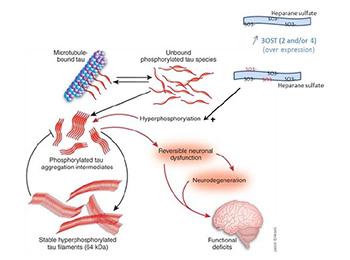
One of the main pathological hallmarks of Alzheimer’s Disease (AD) is the presence of abnormally phosphorylated Tau protein that aggregates to form neurofibrillary tangles (NFTs), which accumulate in affected neurons to finally kill cells. Currently, the abnormal phosphorylation of Tau is considered as the ‘point of no return’ in AD neurodegeneration. Recent findings demonstrate that the glycansulfotransferase HS3ST2, responsible for the synthesis of 3-O-sulphated heparan sulphates (3OHS), is overexpressed in AD patients’ brain and that 3OHS are required for the pathological phosphorylation of Tau. In a zebrafish tauopathy model, the inhibition of HS3ST2 markedly reduces Tau abnormal phosphorylation and restores the wild-type phenotype. The present offer relates to the identification of novel potential therapeutic targets for the development of new mechanism-based anti-AD drugs, able to directly and efficiently avoid the abnormal phosphorylation of Tau protein before this occurs.
International patent application WO2013053954
Alzheimer’s disease - Tau - Tauopathy - Sulfotransferase