Tout s’accélère.
Et vous ?

Erganeo se tient à votre écoute.
votre sujet

REGENERATION OF ACTIVATED CARBON FIBER BY ELECTRO-FENTON PROCESS

REGENERATION OF ACTIVATED CARBON FIBER BY ELECTRO-FENTON PROCESS


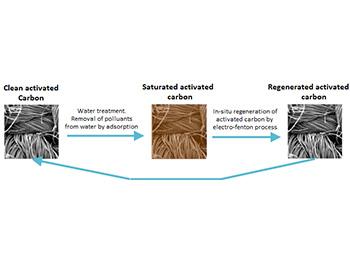
The development of efficient water filtration systems is an important challenge for environmental engineering. Activated carbon is widely used for adsorption of organic pollutants. However, it is only a separation process and current regeneration processes all present some important drawbacks. A new electrochemical process for in situ regeneration of activated carbon fibers has been developed. Activated carbon fibers allow for fast adsorption of organic pollutants and are subsequently used as cathode during the regeneration process. The objective is to recover the adsorption capacity of the initial material and to degrade organic pollutants.


Applications

  • Drinking water
  • Food industry
  • Water purification
  • Wastewater
  • Blood filtration


Competitive advantages

  • Up to 10 regeneration cycles, allowing to considerably decrease the cost of activated carbon fibers
  • In-situ regeneration of activated carbon fibers (no need to extract the filter to regenerate)
  • No loss matter during regeneration (compared to thermal regeneration)
  • Higher performance of fibers compared to granular activated carbon (high adsorption capacity, fast adsorption kinetics)
  • None attrition / oxidation of the activated carbon fibers thanks to cathodic polarization protection
  • Complete degradation and mineralization of organic pollutants No biological activity development inside the filter
  • Process performed at atmospheric pressure and ambient temperature Compact, robust, high automation and easy operation process (current intensity is the main operating condition)


Intellectual property

Patent ref. Number PCT : PCT/EP2019/055803


Keywords

Water treatment - Activated carbon regeneration - Electro-Fenton - Oxidation of organic pollutants - Activated carbon fiber - Degradation and mineralization of organic pollutants


Télécharger la fiche de technologie