Erganeo is at your disposal.
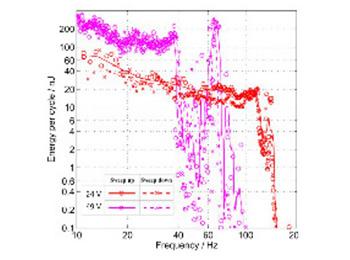
For embedded systems, battery liftetime is often a critical issue and finding ways to increase it could provide major benefits. For example, improving the battery lifetime of pacemakers would postpone the chirurgical operation needed to replace the battery, while for smart clothes, tackling the battery issue would open a wide range of new applications. When the embedded system is a wearable one, it is possible to harvest the mechanical energy due to human movements and convert it into electrical energy. But mechanical energy harvesters work efficiently only at a given mechanical frequency which is linked to their size. So when it comes to designing a miniature energy harvester, the mechanical frequency generally exceeds 100 Hz, far beyond the spread of human movements.
Our MEMS electrostatic harvester has an internal structure designed to provide electrical power efficiently at low and wideband frequencies, making it suitable for wearable devices.
International patent application
Vibration energy Harvesting - MEMS - Low frequency operation - Electrostatic transducer
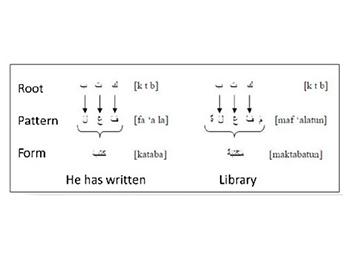
In most languages, common nouns, adjectives and verbs can take very various forms in sentences, depending on the grammatical rules of the language. This is especially true in the Arabic language, where a single root of three consonants can generate hundreds of different forms.
While traditional dictionaries cover only a small fraction of the whole range of forms found in texts, our technology has been used to generated a database of 65 000 entries with their 6 millions of forms, covering more than 98 % of the forms found in any sort of text (literature, newspaper articles etc.), the remaining 2% including proper names.
Arabic Lexicon interfaces with Unitex, which is an open source corpus processing system for language processing, developed by Gaspard Monge Laboratory (LIGM UPEM).
Unitex Arabic has been presented to prestigious organizations, like Al-Ghazali Institute of La Grande Mosquée de Paris and L’Institut du Monde Arabe. It now can be used in a wide range of domains, like text editors, digitalization of printed documents, data mining in Arabic web contents and e-learning of Arabic.
Copyright
Semitic languages - Arabic - Orthography - Grammar - Unitex
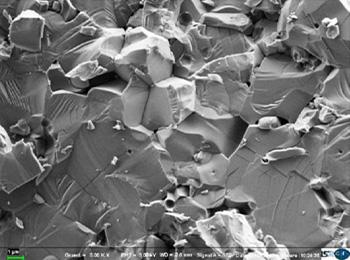
Boron phosphides (BP and B12P2) are characterized by high hardness (Hv > 30GPa), low density, high thermal conductivity and a high thermal and chemical stability (up to 1500K in air).
They can be used in many industries including automotive, mechanical engineering and mining as cutting tools, construction part or wear-resistant coatings.
However, these promising two materials are not yet industrially used because of the lack of mass production method. Currently polycrystalline boron phosphides powders are traditionally synthesized by slow processes requiring toxic and aggressive reagents and high energy.
Two new approaches of producing boron phosphide powders have been discovered and patented. These 2 processes, SHS (Self-Propagating High-Temperature Synthesis) and mecanochemistry, enable to synthesize either BP or B12P2 nanopowders with high purity (>97%), from readily available and non-toxic reagents. These new fast, safe, reproducible and scalable syntheses now enable the development of a wide use of boron phosphides.
2 patent families : WO2015097244, WO2016184608
Boron phosphide - BP - B12P2 - Synthesis - SHS - Mecanochemistry - High hardness - Hard material - Ceramic
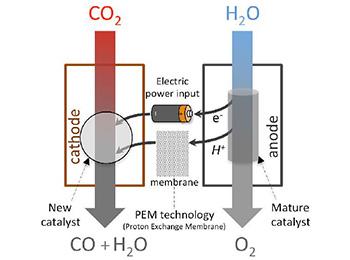
CO2 is a highly stable molecule that needs a lot of energy in order to be transformed and react with other molecules. Hence, CO2 utilization by the industry has remained limited. However, one could see CO2 as a source of carbon and use this material to store energy by breaking C-O bonds and making energy-rich C-H bonds instead. Over the past 20 years, thousands of scientific articles about CO2 catalyzed reduction have been published but the reported catalysts are either based on rare materials (such as Pd, Re, Ru) or show poor performances. In contrast, our PEM technology based on iron porphyrin catalysts is very promising since it does not rely on rare materials and has proved excellent performances to turn CO2 into CO at ambient temperatures both in organic and neutral pH aqueous solutions. Electrogenerated CO could be further processed with green hydrogen for synthetic fuel production.
CO2 valorization - CO2 electroreduction - Low cost catalyst - Iron porphyrin - Carbon monoxide - Synthetic fuels - Syngas - Electrofuels - Energy conversion and storage
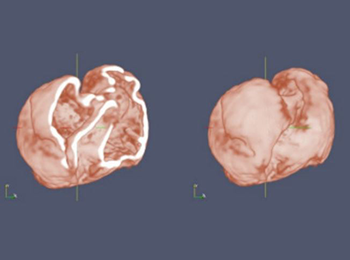
While 3D imaging of adherent cells is provided with almost all microscopes, there is currently no reliable and reproducible method for the non-adherent cells. The device presently proposed combines a microfluidic circuit, an electromagnetic field generator and a control software. The combination of these three elements allows studying the cell and its environment in three dimensions while minimizing the exogenous constraints. This solution opens up new fields of basic research in embryology (i.e. monitoring the fusion of gametes), hematology (i.e. liquid cancers) and microbiology.
Applications:
Competitive advantages:
Keywords: Imaging, Biology, Non-adherent cell, 3D, 4D, Microscopy, Hematology, Embryology
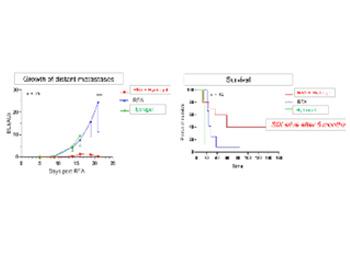
Efficacy of immunotherapies is limited by the poor immunogenicity of some cancers. For example, ~90% of colorectal tumours cannot be targeted as they are qualified as low immunogenic. Radiofrequency ablation (RFA), extensively used for the local destruction of tumours or metastases, is known to activate a tumourspecific T-cells response, still ineffective to avoid recurrence.
The technology relies on a thermosensitive hydrogel injected in the tumour cavity treated by RFA, which delivers, locally and sustainably, immunostimulating agents to initiate an antitumoral immune response directed against distant metastases. The thermosensitive hydrogel allows an optimal delivery in the tumour cavity in its liquid state and a long lasting effect thanks to its gelling at around 30 °C.
In vivo, the in situ immunostimulating thermosensitive hydrogel injection after RFA results in a prolonged survival of mice and a regression of distant microscopic tumours due to a strong systemic antitumor immune response. Furthermore, the immunostimulating thermosensitive hydrogel boosts the regression of macroscopic tumours when associated to RFA and a systemic check point inhibitor
International patent application filed on August 31, 2017
Thermosensitive hydrogel - Drug delivery - Immuno-oncology - Colorectal cancer
Pancreatic ductal adenocarcinoma (PDAC) is the fourth leading cause of mortality in western countries. The prognosis for pancreatic cancer patients is very low. Patients with locally advanced disease have a median survival time of 8 to 12 months, which drops to 3 to 6 months with distant metastasis. Surgical resection is potentially the only curative treatment approach but possible in only 20% of patients. Gemcitabine has become the standard-of-care treatment in 1997 for resected pancreatic cancer patients, as well as locally-advanced and metastatic setting, either as a monotherapy or in combination (with Abraxane or Tarceva). However, benefits are limited, and primary goals of treatment for advanced pancreatic cancer remain palliation and lengthened survival.
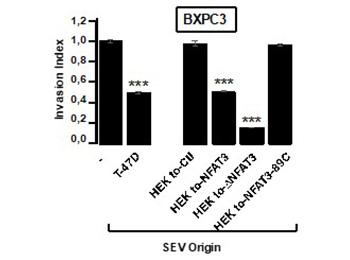
The present offer relates to the use of therapeutic exosomes as an advanced pancreatic cancer treatment and metastasis inhibition. These exosomes are produced from non-tumoral cells (HEKs) that highly express NFAT3, a transcription factor known to decrease cancer cell motility. In vitro evaluation revealed that these exosomes significantly decreased (up to 80%) the invasive capacity of solid tumor cancer cells in a pancreatic cell line (BXPC3). Preliminary in vivo experiments in a xenograft model of PDAC in nude mice are ongoing. This exosome based therapy can be considered as a new promising strategy.
WO2017167788, filed on March 2017
Exosome - NFAT3 - PDAC - Pancreatic cancer
Chemotherapies treatment are limited by their systemic toxicity that reduces their use or requires interruption of the treatment before the planned end. In this context, new formulations of anticancer drugs that improve their benefit/ risk ratio are needed.
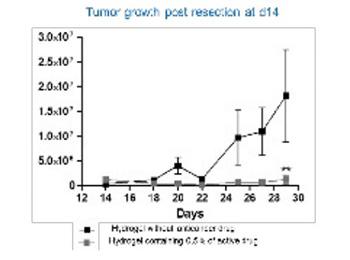
The present invention relies on a thermosensitive hydrogel injected in liquid form in the tumour cavity, which jellifies in situ and delivers, locally and sustainably, anticancer drugs. This new drug delivery system is made of approved components and has been optimized in order to be sprayable or injectable via thin catheters. In vivo experiments, in colorectal cancer mouse models, show the regression of colorectal tumours. In peritoneal carcinomatosis, the in situ thermosensitive hydrogel injection reduces the peritoneal carcinomatosis index. This thermosensitive hydrogel will offer a new solution to improve the efficacy of chemotherapies delivery and reduce their systemic side effect. Its optimized physico-chemical properties (sprayability, viscosity,…) make the hydrogel fits into clinical practice. In the case of peritoneal carcinomatosis, the product represents a less invasive alternative to IPCH surgery.
International patent application filed on September 16, 2016 ; WO2017/046369
Thermosensitive hydrogel - Drug delivery - Chemotherapy - Gastric cancer - Colorectal cancer - Gynaecologic cancer
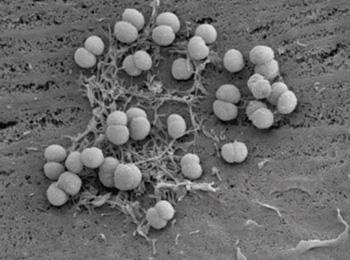
Purpura fulminans (PF) is an uncommon but fatal disorder characterized by rapidly progressive thrombosis with hemorrhagic infarction, disseminated intravascular coagulation and multi-organ failure, which leads to death in 30% of patients and often severe sequelae in survivors. PF is a feature of severe sepsis in response to infection by a wide range of bacteria species, among which Neisseria meningitides, Streptococcus pneumoniae and Escherichia coli. Bacterial colonization of human blood vessel cells is a hallmark of the PF. Rapid administration of antibiotics effectively treats sepsis, but it has only moderate effect on thrombosis development.
The present offer relates to a small molecules family to treat PF. In vitro evaluation of these molecules revealed that they quickly disaggregate bacterial colonies on human endothelial cells, acting on the bacteria type IV pili. The molecules efficacy has been confirmed in vivo using a human skin xenograft in a mouse model, where a drastic reduction of the bacteria colonization of the vascular system is shown. A novel therapeutic strategy can be considered, which would use these molecules to inhibit bacterial virulence without killing the bacteria. The lack of selective pressure should therefore prevent the emerging of resistance towards these small molecules.
Priority patent application, filed on November 5th 2016
Purpura fulminans - Neisseria meningitidis - Bacterial adhesion - Type IV pili
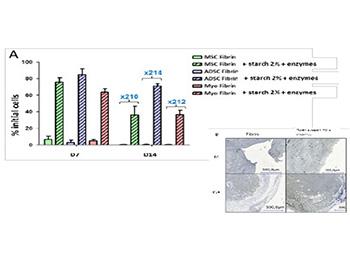
In the growing market of regenerative medicine, the graft of stem cells is a promising strategy but limited survival of cells post implantation reduces its efficacy. The main role of stem cells in tissue regeneration is to release paracrine factors and therefore stimulate the creation of new vessels, cells recruitment and tissue remodeling. Though to have a significant efficacy, stem cells have to stay alive long enough post-implantation in an ischemic environment.
The research team has demonstrated that mesenchymal stem cells (MSCs) can withstand exposure to severe, continuous hypoxia provided that they have access to glucose ,2. Therefore, they designed a biocompatible material which provides a release of glucose, with good mechanical properties making it easy to handle and injectable. The hydrogel is based on a co-polymer of fibrin and starch containing enzymes capable of producing glucose by consuming starch and therefore, inducing an enhancement of stem cell survival. The enzymes can be encapsulated or not in nanoparticles playing a role of reservoir. The hydrogel presents interesting mechanical properties, better in vitro and in vivo stem cells survival (tested on three different cell lines), and in vivo cellular colonization.
The hydrogel can be conditioned in a double-chamber syringe (injectable form) and has been tested under sterile and different storage conditions.
This technology is providing an environment suitable for stem cell survival even under hypoxic conditions.
International patent application filed on September 16, 2016 ; WO2017/046369
Biomaterial - Hydrogel - Stem cells - Regenerative medicine - Tissue engineering - Bone reconstruction
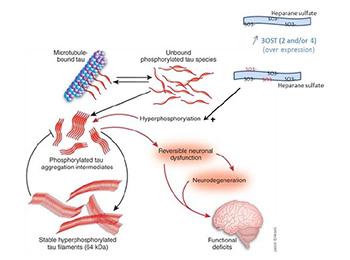
One of the main pathological hallmarks of Alzheimer’s Disease (AD) is the presence of abnormally phosphorylated Tau protein that aggregates to form neurofibrillary tangles (NFTs), which accumulate in affected neurons to finally kill cells. Currently, the abnormal phosphorylation of Tau is considered as the ‘point of no return’ in AD neurodegeneration. Recent findings demonstrate that the glycansulfotransferase HS3ST2, responsible for the synthesis of 3-O-sulphated heparan sulphates (3OHS), is overexpressed in AD patients’ brain and that 3OHS are required for the pathological phosphorylation of Tau. In a zebrafish tauopathy model, the inhibition of HS3ST2 markedly reduces Tau abnormal phosphorylation and restores the wild-type phenotype. The present offer relates to the identification of novel potential therapeutic targets for the development of new mechanism-based anti-AD drugs, able to directly and efficiently avoid the abnormal phosphorylation of Tau protein before this occurs.
International patent application WO2013053954
Alzheimer’s disease - Tau - Tauopathy - Sulfotransferase
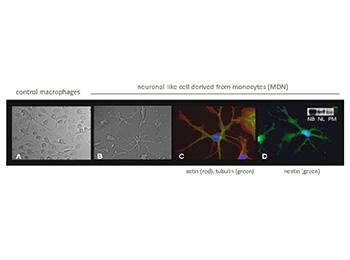
Using patient-specific neuronal cells is a promising approach for the diagnosis and treatment of neurodegenerative diseases and for scientific research. However, current methods to produce or extract neuronal cells are highly invasive or drastically alter the cell genome. The present offer proposes a new method, alternative to iPS, for differentiating white blood cells, extracted from fresh human blood, into neuronal-like cells without cell reprogramming. The resulting cells structurally resemble neurons, present spontaneous electrical activity and express a wide variety of neuronal markers. A 40% differentiation-rate, within 3 weeks, was reached following a simple and robust protocol (developed at Cochin Institute and Sainte-Anne Hospital). This method can be used to generate in vitro models of neuropathologies for drug discovery.
European and United-State patent applications ; Priority patent application filed on Oct 17, 2013 ; EP2862926
Neuronal-like cells - Transdifferentiation - Neurodegenerative diseases - Research tool